
- DeepSeek's Search and Fetch APIs cost $0.75 per 1,000 successful requests each, and failed, empty and timed-out calls aren't billed. Calls made through DeepSeek Harness, Claude Code or Codex are free until 00:00 Beijing time on November 1, 2026, per DeepSeek's docs checked October 20, 2026.
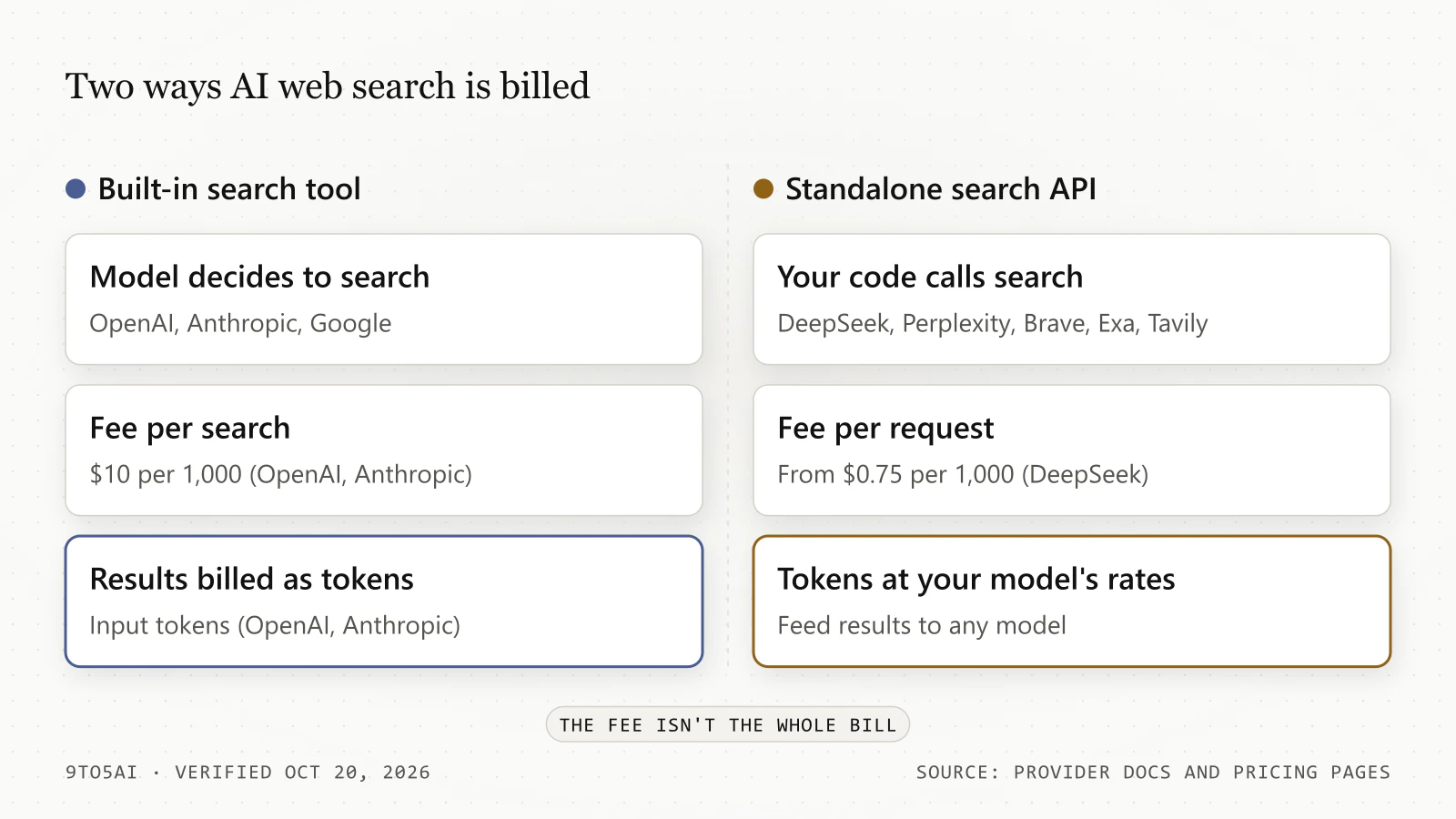
- OpenAI's web search tool and Anthropic's web search tool both cost $10 per 1,000 calls plus the tokens of the search results. Anthropic's web fetch tool adds no fee beyond tokens. Google charges $14 per 1,000 search queries after 5,000 free a month on the Gemini API paid tier.
- Perplexity's Search API costs $5 per 1,000 requests, or $1 with Fast Search. Its docs say Sonar Chat Completions is now the Agent API. Brave lists $5 per 1,000 searches, Exa $7 and Tavily 1 credit ($0.008 pay-as-you-go) per basic search.
Contents
An AI web search API lets a model or coding agent search the live web and read pages. On October 17, 2026, DeepSeek opened its own Search and Fetch APIs at $0.75 per 1,000 successful requests each, more than ten times below the $10 per 1,000 that OpenAI and Anthropic charge for their search tools. This comparison sets out, as of October 20, 2026, what each option returns, how it's billed, free tiers, rate limits, supported models, citation rules and data retention.
This comparison is based on the official API docs, pricing pages and terms of DeepSeek, OpenAI, Anthropic, Google, Perplexity, Brave, Exa and Tavily, checked October 20, 2026. For the DeepSeek model released the same day as the search APIs, see our DeepSeek V4.1 Flash 1017 story. Prices are US list prices; model tokens are extra unless stated.
The short version
- Cheapest per search fee: DeepSeek, $0.75 per 1,000 successful Search requests and $0.75 per 1,000 Fetch requests. Calls through DeepSeek Harness, Claude Code or Codex are free until November 1, 2026 (00:00 Beijing time).
- Built into the big model APIs: OpenAI and Anthropic charge $10 per 1,000 searches, plus the search results as input tokens. Anthropic's web fetch tool has no fee beyond tokens.
- Google: grounding with Google Search on Gemini 3 and newer models is billed per search query the model runs: 5,000 free a month on the paid tier, then $14 per 1,000. It isn't available on the free tier for Gemini 4 Argon.
- Perplexity: the Search API costs $5 per 1,000 requests, or $1 with Fast Search. Perplexity's docs say Sonar Chat Completions has become the Agent API.
- The fee isn't the whole bill. With the model vendors' tools, search results are also billed as input tokens.
How much does each AI web search API cost?
| Provider and product | What you get back | Billing unit and list price | Free allowance |
|---|---|---|---|
| DeepSeek Search API | Ranked results: title, URL, snippet, summary, optional page content, date, rerank and authority scores | $0.75 per 1,000 successful requests; empty results, failures and timeouts not billed | Free via DeepSeek Harness, Claude Code or Codex until 00:00 Beijing time, Nov 1, 2026 |
| DeepSeek Fetch API | One page as Markdown, plus its title | $0.75 per 1,000 successful requests | Same as Search |
| OpenAI web search tool (Responses API) | Model answer with clickable URL citations; optional full list of sources | $10 per 1,000 calls, plus search content tokens at model rates | None listed |
| OpenAI web search preview, non-reasoning models (legacy) | Model answer with citations | $25 per 1,000 calls; search content tokens free | None listed |
| Anthropic web search tool (Claude API) | Model answer with citations; results with URL, title, page age, encrypted content | $10 per 1,000 searches, plus results as input tokens | None listed |
| Anthropic web fetch tool (Claude API) | Full text of a web page or PDF, read by Claude | No fee; fetched content billed as tokens | n/a |
| Google grounding with Google Search (Gemini 3 and newer) | Model answer with URL citations, plus a Search Suggestions HTML snippet | $14 per 1,000 search queries; one prompt can trigger several | 5,000 search requests a month on the paid tier, shared across Gemini 3 and newer models; not on the free tier for Argon or 3.8 Flash |
| Perplexity Search API | Ranked results: title, URL, snippet, date, last updated | $5 per 1,000 requests; $1 with Fast Search; up to five queries per request count as one | None listed |
Perplexity Agent API web_search tool | Results the chosen model uses to answer | $2.50 per 1,000 invocations; $1 with Fast Search, the default in its presets; plus model tokens | None listed |
Perplexity Agent API fetch_url tool | Page content | $0.50 per 1,000 invocations ($0.0005 each), plus tokens | None listed |
| Brave Search API | Search results | $5 per 1,000 requests | $5 in credits a month |
| Brave Answers | Model answer | $4 per 1,000 queries, plus $5 per million input and output tokens | $5 in credits a month |
| Exa Search | Up to 10 results per request in the base price | $7 per 1,000 (auto, fast); $4 (lite, instant); $12–$15 for deep modes | $10 in credits a month |
| Exa Contents | Page text, highlights or summary | $1 per 1,000 pages per content type | Same credits |
| Tavily Search | Search results | 1 credit (basic) or 2 credits (advanced) per request; $0.008 per credit pay-as-you-go | 1,000 credits a month |
| Tavily Extract | Page content | 1 credit per 5 successful URLs (basic) | Same credits |
Table 1DeepSeek's $0.75 per 1,000 is the lowest search fee listed; OpenAI's and Anthropic's tools add the search results as tokens on top of $10 per 1,000. Source: each provider's docs and pricing pages, checked October 20, 2026.
Last verified: October 20, 2026 (official docs and pricing pages listed under Sources; every row with its source link is in our data file D27-ai-web-search-apis.csv)
How the tokens change the bill:
- OpenAI says web search content tokens are "tokens retrieved from the search index and fed to the model alongside your prompt," billed at the model's rates. For
gpt-4o-miniandgpt-4.1-minithey're billed as a fixed block of 8,000 input tokens per call. Its guide caps Responses API search context at 128,000 tokens even on models with larger windows. - Anthropic says search results "are counted as input tokens" in the turn where they're retrieved and in later turns. Its pricing page estimates a fetched 10 kB page at about 2,500 tokens and a 500 kB PDF at about 125,000.
- Google's pricing page says retrieved grounding context "is not charged as input tokens" only for its Nano Banana image models; for text models it doesn't say.
- DeepSeek, Perplexity's Search API, Brave, Exa and Tavily return results to your own code. What you then pay depends on the model you feed them to. For how that model choice moves the total, see frontier APIs vs open models.
What does 10,000 searches a month cost?
This is an illustrative calculation from list prices, not a measurement. It counts the search fee only, for 10,000 successful searches in a month, after any monthly free allowance. It excludes model tokens and the DeepSeek promotion.
Last verified: October 20, 2026 (illustrative calculation from the prices above)
Searches per user question vary. Google says one request "may result in one or more queries to Google Search," each billed, and Anthropic says simple factual questions "typically use 1–3 searches" while comparative research "can use 10 or more."
What are the free tiers and rate limits?
| Provider | Free tier | Rate limits, per the docs |
|---|---|---|
| DeepSeek | Promotion: free through Harness, Claude Code or Codex until Nov 1, 2026 | Search 100 queries per second (QPS), Fetch 25 QPS plus a per-domain limit, per account |
| OpenAI | None listed | "Same as tiered rate limits for underlying model used with the tool" |
| Anthropic | None listed | Organization-level, shown in the Claude Console; the Batches API throttles search per organization |
| 5,000 search requests a month on the paid tier; free tier "Not available" for Argon and 3.8 Flash ("can be tested in Google AI Studio" for some models) | Not stated on the pages read | |
| Perplexity | None listed | On a separate page; each query in a multi-query request counts toward limits |
| Brave | $5 in credits a month (Search and Answers) | Search 50 QPS; Answers 2 QPS |
| Exa | $10 in credits a month, no card needed | Not listed except custom QPS for Enterprise |
| Tavily | 1,000 credits a month | Not on the credits page |
Table 2Only Google, Brave, Exa and Tavily list a standing free allowance; DeepSeek's free calls are a promotion that ends November 1, 2026. Source: each provider's docs and pricing pages, checked October 20, 2026.
Last verified: October 20, 2026
These DeepSeek limits are higher than the 5 QPS per account for each endpoint reported in our October 18 story on DeepSeek V4.1 Flash 1017.
Which models does each search tool work with?
- DeepSeek: standalone HTTP endpoints, so any model or agent can call them. The guide describes them as serving "agents and RAG applications" and names no models. The free period covers server-side tool calls in DeepSeek Harness, Claude Code and Codex when they run on the DeepSeek API.
- OpenAI: the
web_searchtool in the Responses API. The guide's examples usegpt-6-astra; it describes agentic search with reasoning models and a deep research mode. In Chat Completions, search uses the separategpt-5-search-apimodel, without domain filters. - Anthropic: the
web_searchandweb_fetchtools in the Messages API. Dynamic filtering, where Claude writes code to filter results before they reach the context window, needs Claude 4.6 or later. Web search isn't available on Amazon Bedrock, and Google Cloud gets only the basic version. Web fetch isn't available on Bedrock or Google Cloud. - Google: the Gemini API's grounding page lists Gemini 4 Argon, 3.8 Flash, 3.6 Flash, 3.5 Flash-Lite and older 3.x and 2.5 models (plus Gemini 2.0 Flash, which Google's models page now marks as shut down). Gemini 2.5 and older are billed per prompt rather than per query.
- Perplexity: the Agent API runs third-party models, including OpenAI, Google, Anthropic and xAI models, plus Perplexity's own
sonar, withweb_searchandfetch_urlas tools.
What citation and display rules come with the results?
These are contract terms, and they differ more than the prices.
| Provider | What the docs or terms require |
|---|---|
| OpenAI | Its guide says "inline citations must be made clearly visible and clickable in your user interface" |
| Anthropic | Citations are always on for web search. When you show API output directly to users, "citations must be included to the original source"; if you modify or combine output, Anthropic says to consult your legal team. Fetch citations are optional |
| Show Grounded Results only with the associated Search Suggestions, only to the user who sent the prompt; don't modify them or intersperse other content; no caching, syndicating, reselling or training on them; text may be kept up to two years for listed purposes (Gemini API terms, updated April 28, 2026) | |
| Brave | Storing results or training models needs a plan that includes storage rights, per its API page |
| DeepSeek, Perplexity, Exa, Tavily | No display rule on the pages read; Perplexity says result id and url are "the source of truth for citations" |
Table 3Google's terms go furthest, setting how grounded results are shown and barring caching, reselling or training on them; four providers state no display rule on the pages read. Sources: each provider's docs and terms, checked October 20, 2026.
Last verified: October 20, 2026
What do the docs say about data retention?
- Anthropic: web search and web fetch are eligible for zero data retention (ZDR); web search is also HIPAA-eligible, web fetch isn't. Dynamic filtering is eligible for neither. Anthropic notes that site publishers "may retain request data (such as fetched URLs and request metadata)."
- OpenAI: the Responses API is ZDR-eligible with limitations and keeps abuse-monitoring data for 30 days. Web search with live internet access "is not HIPAA eligible and is not covered by a BAA"; the offline, cache-only mode (
external_web_access: false) can be, in a ZDR organization. - Google: its terms say Google stores prompts, contextual information and output for 30 days to create grounded results. On unpaid services, Google uses submitted content to improve its products; on paid services it says it doesn't.
- Brave: "Full-funnel Zero Data Retention" is listed for Enterprise.
- DeepSeek, Perplexity, Exa, Tavily: the pages read don't address retention. In the Hacker News thread on DeepSeek's launch (Tier 3, user opinion), one commenter said the missing ZDR option was the thing they "cannot get over."
Which AI web search API should you pick?
| If you need… | Start with | Why |
|---|---|---|
| The lowest per-search fee for your own agent | DeepSeek Search and Fetch | $0.75 per 1,000 successful calls each, failures not billed |
| Search inside Claude with the fewest moving parts | Anthropic web search and web fetch | $10 per 1,000 searches, no fetch fee; ZDR-eligible |
| Search inside an OpenAI agent, with domain filters | OpenAI web_search (Responses API) | Up to 100 allowed or blocked domains; $10 per 1,000 calls |
| Google's index in a Gemini app, at low volume | Gemini grounding with Google Search | 5,000 free queries a month on the paid tier, then $14 per 1,000; strict display terms |
| Raw results to feed any model, with a monthly free allowance | Brave, Exa or Tavily | $5, $10 or 1,000 credits a month free, respectively |
| Fast, cheap raw results from a search-first company | Perplexity Search API with Fast Search | $1 per 1,000 requests, up to five queries per request |
| Regulated data (HIPAA) | Anthropic web search without dynamic filtering, or OpenAI's cache-only mode | Only options the docs mark as HIPAA- or BAA-eligible |
Table 4Our starting points by need, based on the prices, terms and limits above; none of them rests on a test of result quality.
Last verified: October 20, 2026
Whichever you choose, anything an agent reads from the web is untrusted input; our prompt injection explainer covers why that matters once search results flow into a model with tools. And the pages themselves may not let the agent in: our analysis of websites closing their doors to AI agents covers the blocking side, and our guide to detecting AI agents shows what site owners see.
What's confirmed, reported and uncertain
- Confirmed (official docs and pricing pages, October 20, 2026): every price, free allowance, rate limit, model list, citation rule and retention statement in the tables above.
- Sonar: Perplexity's old Sonar Pro page now redirects to a migration guide that says "Sonar Chat Completions support ended on September 27, 2026." Synchronous and streaming Sonar requests are being converted into Agent API requests, model by model, and asynchronous ones are no longer supported. Its changelog says Sonar Chat Completions "is now Agent API." We don't list Sonar as a current product.
- Conflicting: Brave's API page says "up to $20 in free calls every month" in one place and $5 in monthly credits in its plan list.
- Uncertain: DeepSeek's Search guide and pricing page state no data-retention terms or display rules. Google's pricing page doesn't say whether grounded context on its text models is billed as input tokens. This comparison covers price, terms and limits, not the quality of each provider's results, and cites no evaluation of result quality.

About this storyBased on the sources linked below. Editorial standards


