
- Meta said on October 19, 2026, that the first phase of Prometheus, its 'gigawatt-scale' supercluster in New Albany, Ohio, is complete and was used to train its Muse models. It now has 'hundreds of thousands of GPUs' across multiple buildings.
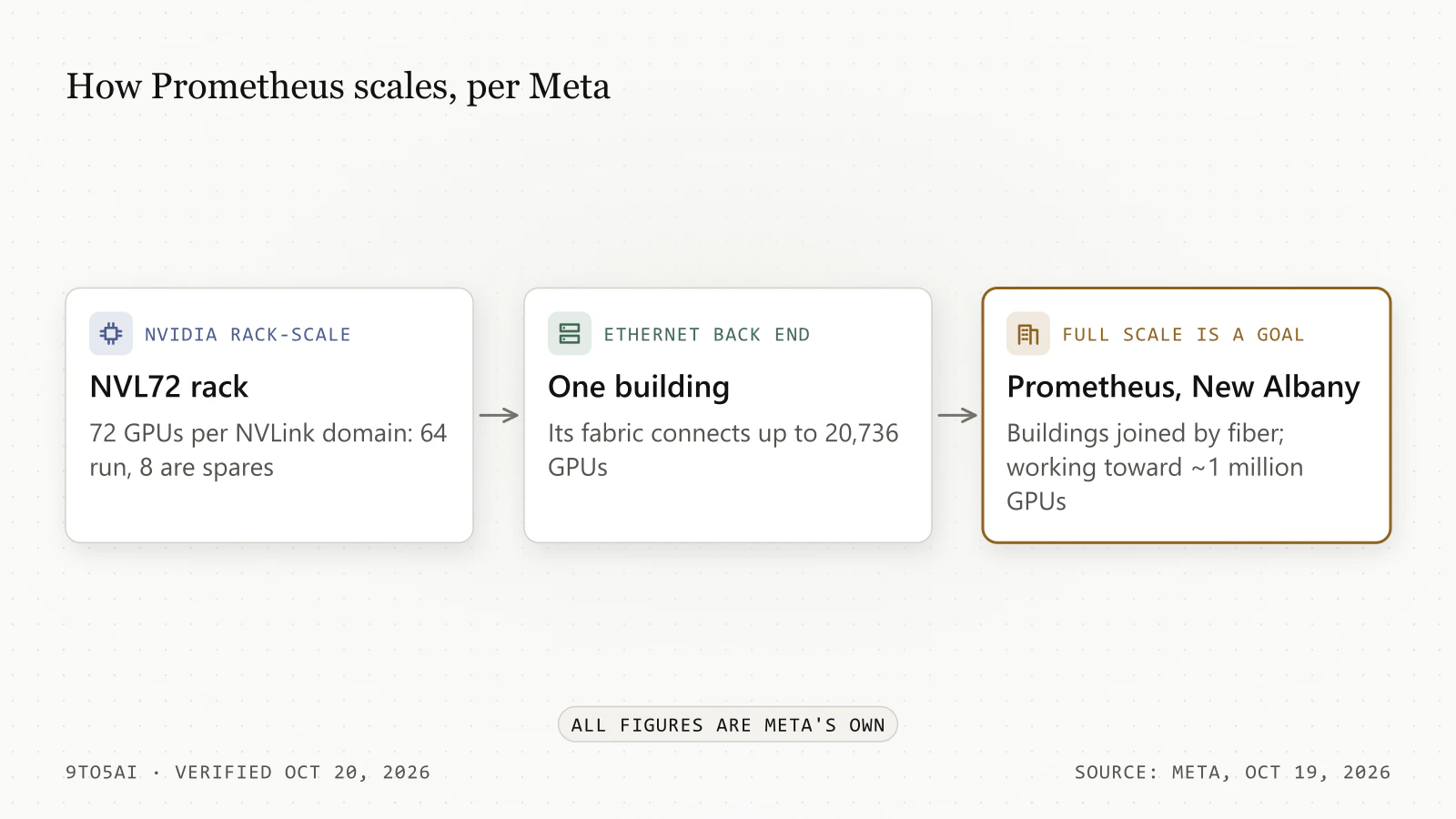
- Meta says it is working toward about 1 million GPUs, described as 'distributed' across buildings, not one hall. It runs Nvidia GB200 and GB300 NVL72 racks today, with Vera Rubin NVL72 next. It gives no date or megawatt figure.
- Meta reports more than 85% pre-training goodput and a 99% cut in training interruptions since mid-2025. These are Meta's own figures, not independently checked.
Contents
On Monday, October 19, 2026, Meta published a detailed engineering account of Prometheus, its AI training supercluster in New Albany, Ohio, and one of the largest projects in the AI datacenters race. Meta says the first phase of the "gigawatt-scale" Meta Prometheus supercluster is complete and was used to train its Muse models. The site now runs "hundreds of thousands of GPUs." Meta says it is working toward "roughly 1 million distributed GPUs, all functioning in lockstep." It gives no date for reaching that number.
This story is based on Meta's October 19 engineering post by Kevin Lee, Yashar Bayani, Ahmed Sharif and Yee Jiun Song, Meta's earlier statements on Prometheus and Hyperion, and TechCrunch's July 2025 report, checked October 20, 2026. Performance and reliability figures are Meta's own. Prometheus already appears in our gigawatt datacenter tracker, which listed its status as "not published." Meta's post partly answers that.
The short version
- Where: New Albany, Ohio. Meta says that two years ago it was "a conventional data center site" serving web traffic.
- Status: phase one complete; it trained the Muse family. Meta's Muse Wonder release also says those models were trained at Prometheus.
- Size today: "hundreds of thousands of GPUs" in multiple connected buildings, including leased capacity and "rapid-deployment structures."
- Target: "~1 million GPUs," spread across buildings. Meta doesn't call it a single building or give a date.
- Power: "gigawatt-scale." No megawatt figure is given in the post.
- Next: Hyperion in Richland Parish, Louisiana, designed with lessons from Prometheus.
Is it really 1 million GPUs on one site?
Not quite, by Meta's own wording. The post says Prometheus "will comprise roughly 1 million distributed GPUs" at full scale, linked by "miles of fiber" across traditional datacenters, AI-optimized buildings, leased capacity from partners and industrial-grade rapid-deployment structures. It describes the cluster working "as a single machine," but it never says "single site" or "single building." Meta's network design also spans links "from 2 km to over 100 km," which points to a campus or a region rather than one hall.
Two more limits matter. "Working toward" means the 1 million figure is a goal. And the post gives no date for it. In July 2025, TechCrunch reported that Mark Zuckerberg said Meta planned to bring Prometheus, a 1 GW cluster, online in 2026. The new post confirms only that phase one is done.
What hardware is in Prometheus?
Meta describes three generations of Nvidia rack-scale systems, all with 72 GPUs per NVLink domain:
| Meta platform | Nvidia system | GPU memory | Power (Meta's figure) | Scale-out network per GPU | Status |
|---|---|---|---|---|---|
| Catalina (Ariel variant) | GB200 NVL72, across two racks | 192 GB HBM3e | ~120 kW per two-rack system | 800G (two ConnectX-7 400G NICs) | In service |
| Clemente | GB300 NVL72, one rack | 288 GB HBM3e | ~135 kW per rack | 800G (ConnectX-8) | In service; Meta claims a 5–10% gain over GB200 |
| San Miguel | Vera Rubin NVL72 | 288 GB HBM4 | 170+ kW per rack, fully liquid-cooled | Not stated | "Arriving soon"; Meta claims 10–20% better performance per watt than GB300 |
Table 1Meta's power figures climb with each generation, from ~120 kW per two-rack GB200 system to 170+ kW per Vera Rubin rack; the performance gains are Meta's own claims. Source: Meta engineering post, October 19, 2026.
Last verified: October 20, 2026
The gains are vendor-reported projections. Meta doesn't say which workloads they were measured on. Vera Rubin's broader rollout is covered in our Vera Rubin story.
How is it networked?
GPU-to-GPU traffic runs over a dedicated Ethernet back-end network, Meta says. Each building's fabric connects up to 20,736 GPUs. Meta first used its Disaggregated Scheduled Fabric, then moved to a "Non-Scheduled Fabric" built on 51.2T shallow-buffer switches, including Nvidia Spectrum-4-based Minipack3N, with Nvidia Adaptive Routing on the NICs. Buildings are joined by a Backend Aggregation layer using Arista 7800-series chassis with Broadcom Jericho3 chips. Meta says the whole system uses tens of thousands of switches, millions of optics and 800G-ZR coherent optics for links beyond about 10 km.
What about reliability, power and cooling?
Reliability. Meta reports pre-training goodput above 85% (the share of time doing useful training) and above 90% for reinforcement learning. It says interruptions peaked near 1,000 per 8,000 GPUs per day in mid-2025 and have since fallen 99%. Its goal is two per 8,000 GPUs per day. To keep jobs running, each NVL72 rack runs 64 GPUs and holds 8 as spares. For a 32,768-GPU run, Meta provisions 523 racks (37,656 GPUs). Meta puts that margin at about 13% of the footprint, mostly (11%) from the 64-of-72 layout, plus roughly 2% of racks held in reserve for whole-rack faults. These are Meta's figures and haven't been independently verified.
Power swings. Synchronous training can swing a cluster's load by 30–40%, or tens of megawatts in seconds, Meta says. It smooths this with gradual power capping, rack batteries, capacitor trays, facility battery storage and coordination with utilities. Meta says it pays the full cost of energy in New Albany and works with developers to match its use with clean and renewable energy. The post doesn't mention on-site generation.
Cooling. Older free-air buildings and the rapid-deployment structures use air-assisted liquid cooling. The purpose-built AI building uses facility liquid cooling, and newer AI buildings use closed-loop liquid cooling.
How does Prometheus compare with Hyperion?
| Prometheus | Hyperion | |
|---|---|---|
| Location | New Albany, Ohio | Richland Parish, Louisiana |
| Status | Phase one complete (Meta, October 19, 2026) | "Upcoming" (Meta, October 19, 2026) |
| Stated power | "Gigawatt-scale"; 1 GW online in 2026 (Zuckerberg via TechCrunch, July 2025) | 2 GW by 2030, scaling to 5 GW (Meta spokesperson via TechCrunch, July 2025) |
| GPUs | Hundreds of thousands now; ~1 million target | Not stated |
| Cooling | Mix of air-assisted, facility and closed-loop liquid | Closed-loop liquid cooling |
| Grid | Not detailed | Full grid connection with Entergy; Meta pays full cost |
Table 2Hyperion's power figures are plans reported in July 2025, and Meta hasn't said how many GPUs it will hold. Sources: Meta, October 19, 2026; TechCrunch, July 14, 2025.
Last verified: October 20, 2026
Hyperion's financing, an 80/20 joint venture with Blue Owl funds, is covered in our story on banks and datacenter debt.
What's confirmed, reported and uncertain
- Confirmed (Meta, October 19, 2026): location; phase one complete and used for Muse; hundreds of thousands of GPUs today; the ~1 million distributed-GPU goal; hardware, network, cooling and power-management designs; Hyperion's cooling and grid plans.
- Vendor-reported: goodput, interruption rates, the 5–10% and 10–20% generational gains.
- Reported: the 1 GW, 2026 target for Prometheus, and Hyperion's 2 GW and 5 GW figures (TechCrunch, July 14, 2025).
- Uncertain: Prometheus's current power draw in megawatts, when it reaches 1 million GPUs, how much is leased versus owned, and Hyperion's GPU count.

About this storyBased on the sources linked below. Editorial standards


