
- Inception announced Mercury 3 on October 19, 2026. It says the diffusion model runs at 1,068 tokens per second on NVIDIA GPUs, has a 1-million-token context (up from 260K in Mercury 2.5) and matches or beats GPT-6 Luna and Claude Haiku 5.5. All of that is vendor-reported.
- List price is $0.20 per million input tokens and $0.70 per million output tokens, with 50% off at launch ($0.10/$0.35). It's on Inception's API, OpenRouter, Baseten and Vercel. The weights aren't released.
- Autoregressive models write one token at a time. Diffusion models start from masked or noisy text and refine many tokens in parallel. Google's May 2025 Gemini Diffusion results and the 2025 Fast-dLLM paper show the trade-offs: speed, but weaker reasoning scores and harder caching.
Contents
A diffusion language model is a text model that drafts a whole block of tokens at once and then refines it over several passes, instead of writing one token after another. On October 19, 2026, Inception launched Mercury 3, the largest model yet from a company that calls itself the maker of the first commercial diffusion LLMs, and pitched it at the same latency-sensitive jobs as the small, cheap models from OpenAI and Anthropic. Inception says it runs at 1,068 tokens per second and matches or beats GPT-6 Luna and Claude Haiku 5.5. Those claims are vendor-reported, and no benchmark scores were published with them.
This explainer is based on Inception's announcement and press release, its 2025 Mercury paper, OpenRouter's model listing, Google DeepMind's Gemini Diffusion page and the LLaDA and Fast-dLLM papers, all checked October 20, 2026. For the autoregressive models Mercury 3 competes with, see our comparison of cheap, fast models.
The short version
- Diffusion vs autoregressive: autoregressive models generate "one word – or token – at a time," as Google puts it. Diffusion models "learn to generate outputs by refining noise, step-by-step," so many tokens are worked on in parallel.
- Why it matters: parallel refinement can make generation much faster on the same GPUs. That's the whole pitch.
- Mercury 3: Inception's fourth model since Mercury 1 in June 2025. It has a 1M-token context and costs $0.20/$0.70 per million tokens ($0.10/$0.35 at launch). It's API-only.
- Trade-offs: research shows parallel decoding can lose quality, and diffusion models can't reuse a standard key-value cache. Google's experimental Gemini Diffusion trailed a small autoregressive model on several reasoning tests.
How does an autoregressive model generate text?
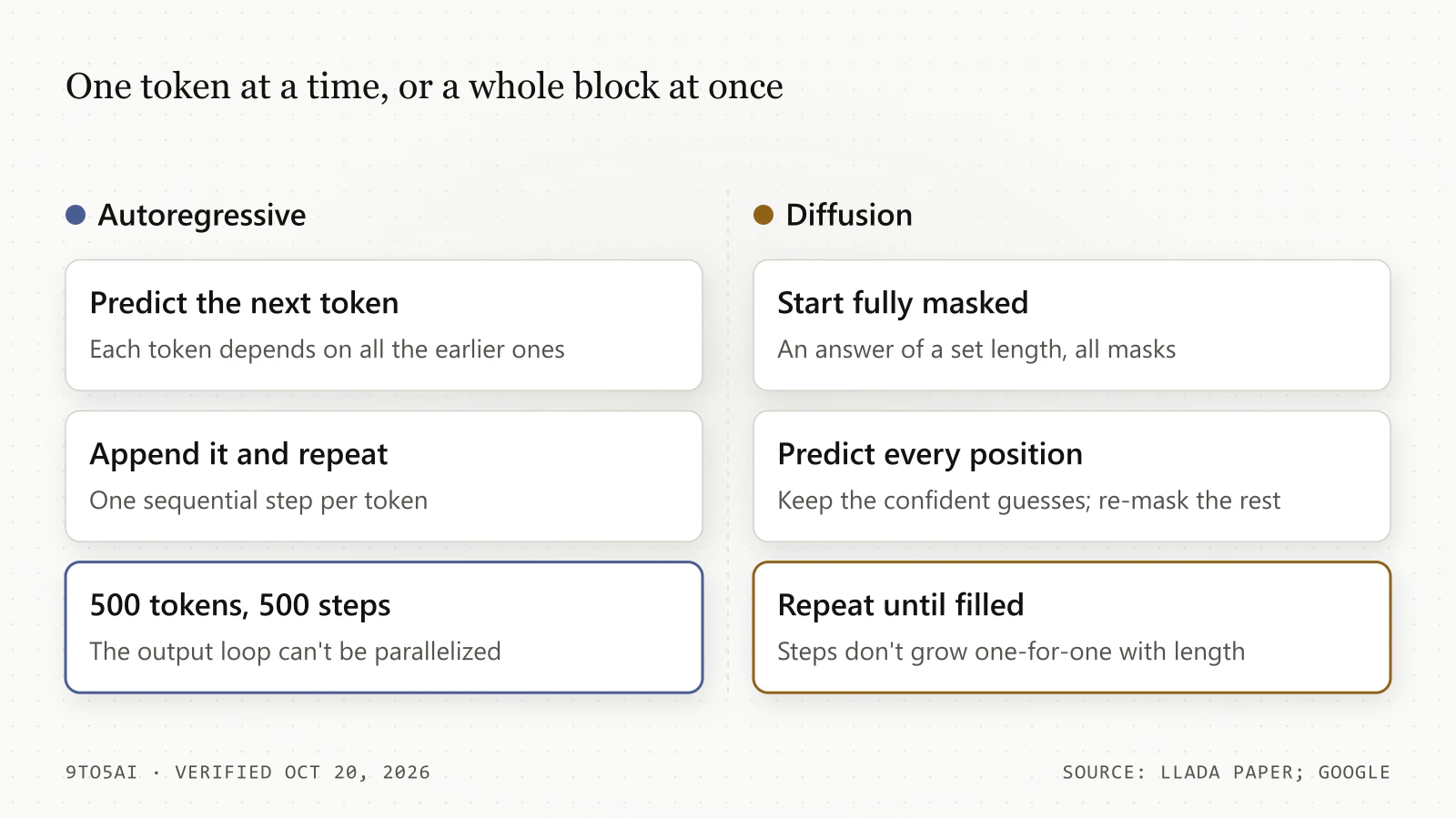
Almost every chatbot you use, from ChatGPT to Claude, is autoregressive. It predicts the next token, appends it, and repeats. Each new token depends on all the earlier ones, so a 500-token answer takes 500 sequential steps. Engineers speed this up with caching and batching, but the sequence itself can't be parallelized.
Reading the prompt, by contrast, can happen in parallel. The sequential output loop is what makes long answers slow, and our reasoning models explainer shows how it adds up when a model "thinks" for thousands of tokens.
How does a diffusion language model generate text?
Diffusion became famous in image generation: models such as FLUX 3 Image Klein start from random noise and remove it over a series of steps until a picture emerges. Text diffusion adapts the idea to tokens.
The best-documented open version is LLaDA (Large Language Diffusion with mAsking), a February 2025 paper by Shen Nie, Chongxuan Li and colleagues at Renmin University of China and Ant Group, who pre-trained an 8B model from scratch on 2.3 trillion tokens. It uses "a forward data masking process and a reverse generation process, parameterized by a Transformer to predict masked tokens." In plain terms:
- Training: take real text, hide a random share of its tokens behind a mask, and train the model to fill them in. Repeat at every masking level, from a few tokens hidden to all of them.
- Generation: start with a fully masked answer of a set length. The model predicts every masked position at once, keeps its most confident guesses, re-masks the rest and tries again. After enough passes, the whole answer is filled in.
Because each pass works on the whole block, the number of steps doesn't grow one-for-one with answer length. The model also sees text on both sides of a gap, which the LLaDA authors say helps with the "reversal curse," the difficulty autoregressive models have when asked for facts backwards. They report that LLaDA 8B "is competitive with strong LLMs like LLaMA3 8B in in-context learning."
Inception describes its own method in similar terms. Its June 2025 Mercury paper says the models use the Transformer architecture and are "trained to predict multiple tokens in parallel." Its February 2026 Mercury 2 release says the model "refines it through a process called denoising — across many tokens in parallel." Google says diffusion lets a model "iterate on a solution very quickly and error correct during the generation process," something a token-by-token model can't do once a token is written.
What's new in Mercury 3?
| Item | Mercury 3 |
|---|---|
| Announced | October 19, 2026 (Inception blog and press release); OpenRouter lists it from October 16 |
| Size | Not disclosed; "more than 40x larger than Mercury 1," Inception says |
| Context window | 1 million tokens (Mercury 2.5: 260K) |
| List price | $0.20 input, $0.70 output per million tokens |
| Launch price | 50% off: $0.10 input, $0.35 output (no end date given) |
| Cached input | 90% off the input price |
| Free tier | 100 million tokens on Inception's API platform |
| Where | Inception API (OpenAI-compatible), OpenRouter, Baseten, Vercel |
| Weights | Not released |
| Speed claim | 1,068 tokens per second "on NVIDIA GPUs" (vendor-reported; GPU model not named) |
Table 1Price, context and availability are confirmed; the speed claim and the size comparison are Inception's own, and the parameter count isn't disclosed. Source: Inception and OpenRouter.
Last verified: October 20, 2026
For comparison, Claude Haiku 5.5 and GPT-6 Luna both list at $0.10 input and $0.50 output, per our cheap-models comparison. So Mercury 3 is cheaper on output than both only while the launch discount lasts. At list price, its output tokens cost 40% more.
How fast is Mercury 3, really?
Vendor-reported: 1,068 tokens per second, and "4–8x faster" than GPT-6 Luna and Claude Haiku 5.5. Inception doesn't name the GPU, the prompt and output lengths, or who measured it. Earlier Inception speed claims came with an outside source: its 2025 paper cited Artificial Analysis for 1,109 tokens per second (Mercury Coder Mini) and 737 (Mercury Coder Small) on Nvidia H100s. The Mercury 3 materials don't cite a third party.
Router-observed: OpenRouter's Mercury 3 page reports rolling 30-minute medians from live traffic through its only provider, Inception. On October 20 it showed a median throughput of 183 tokens per second; an earlier reading the same day showed 383, so the figure moves with traffic. Router figures blend many request types and include network and queueing time, so they aren't a like-for-like test of the vendor claim. They do suggest real-world speed can be well below the headline number.
Quality: Inception says Mercury 3 is "on par or better than" GPT-6 Luna and Claude Haiku 5.5 "across a range of benchmarks," but its chart lists no scores in text. The one task result in the post is partner-reported: TinyFish says Mercury 3 completed 50% of 50 live Mind2Web web-navigation tasks in its own production harness, "significantly more than GPT-6.1-Sol." That's a single customer's test with a small sample, so it can't support general rankings.
What are the trade-offs?
The research record shows real costs alongside the speed:
- Parallel decoding can hurt quality. The Fast-dLLM paper (Chengyue Wu and colleagues, May 2025) attributes quality loss in parallel decoding to "the disruption of token dependencies under the conditional independence assumption." When a model fills two linked tokens at once, it may pick ones that don't fit together. Its fix is to commit only tokens above a confidence threshold, which recovers quality but takes more passes.
- Caching is harder. The same paper says open diffusion LLMs lagged in practical speed partly because of a "lack of Key-Value (KV) Cache," the trick autoregressive models use to avoid recomputing earlier text. Fast-dLLM proposes an approximate block-wise cache and reports up to 27.6x throughput gains on LLaDA and Dream with "minimal accuracy loss." Commercial systems like Mercury don't publish how they handle this.
- Reasoning scores have lagged. Google's Gemini Diffusion page (May 2025) compares its experimental model with Gemini 2.0 Flash-Lite on ten tests, most of them coding. Diffusion scored higher on LiveCodeBench v6 (30.9% vs 28.5%) and AIME 2025 (23.3% vs 20.0%), but lower on GPQA Diamond (40.4% vs 56.5%), Global MMLU Lite (69.1% vs 79.0%) and BIG-Bench Extra Hard (15.0% vs 21.0%). These are Google-reported numbers for a model more than a year old. They describe that model, not Mercury 3.
- Length is chosen up front. In LLaDA, generation length is a setting: sampling starts from "the fully masked sentence" of that length, and tokens after the end marker are discarded. The paper also supports block-by-block sampling, which scored higher on its math tests for the instruction-tuned model.
Google's model page still describes Gemini Diffusion as "an experimental demo."
When does a diffusion LLM make sense?
Inception's customers point to jobs where latency matters more than top-end reasoning: browser agents, tutoring feedback that comes back "in about a second," real-time search answers and customer support. Those are the same jobs teams give to Haiku- or Luna-class models. If your workload is many short, fast calls, Mercury 3 is worth comparing on your own prompts. If it depends on long reasoning chains, the evidence that diffusion matches autoregressive models there is thin.
The 1M-token window doesn't change the basics of context, either: our explainer on context windows, memory and RAG covers what a large window does and doesn't buy you.
What's confirmed, reported and uncertain
- Confirmed (Inception, OpenRouter): launch date, 1M context, prices and launch discount, cached-input discount, free tier, availability on four platforms, no open weights.
- Vendor-reported: 1,068 tokens per second, "4–8x faster," quality "on par or better" than GPT-6 Luna and Claude Haiku 5.5, "more than 40x larger than Mercury 1."
- Partner-reported: TinyFish's 50% Mind2Web completion and the education, search and support quotes.
- Uncertain: parameter count, the GPU behind the speed claim, benchmark scores, when the launch discount ends, and any independent evaluation of Mercury 3.

About this storyBased on the sources linked below. Editorial standards


