
In 20 seconds
- Goodfire's Nick Cammarata argues in "Neural Networks Are Already Clean" (a LessWrong linkpost is dated October 15, 2026) that most apparently mixed-up neurons were misread, and that superposition should be a 'last-resort hypothesis.' The essay calls itself a working hypothesis.
- His evidence is mostly from vision models: InceptionV1's last layer goes from about 5% readable neurons with 2017-era tools to about 99% in a same-size ConvNeXt. For language models he reports preliminary Qwen3-32B audits: roughly 90% of neuron poles have one main job. The detailed language-model paper isn't out.
- Named researchers are skeptical. In MIT Technology Review on October 19, 2026, Google DeepMind's Neel Nanda said it isn't 'a significant update to the big picture,' and Stanford's Chris Potts said nothing in it 'makes the problems any easier.' No public response from Anthropic had appeared as of October 23, 2026.
On this page
"Neural networks are already clean" is the title and thesis of a long essay by Nick Cammarata, a researcher at the interpretability startup Goodfire, which a LessWrong linkpost dates to October 15, 2026. It argues that the individual neurons inside frontier AI models are far easier to read than the field has assumed, and that "superposition," the idea that networks cram many unrelated concepts into each neuron, was largely a misreading. MIT Technology Review called it "the explosive claim that's upended the AI world" on October 19. The essay describes itself as a working hypothesis, and its language-model evidence is preliminary.
This explainer is based on the essay itself, Anthropic's 2022 and 2023 interpretability papers, MIT Technology Review's October 19 report, The Decoder's October 16 report and the LessWrong discussion, all checked October 23, 2026. If interpretability is new to you, our guide on how to read a system card shows where these methods turn up in labs' safety reports.
The short version
- The claim: most "polysemantic" neurons, ones that seem to respond to unrelated things, actually do one job that people described badly. The rest of the mess came from "ordinary, mostly fixable issues," such as weak tools and older architectures.
- The evidence: mostly from InceptionV1, the Google image model at the center of the 2020 "Zoom In" circuits work, and newer image models. For language models, the essay reports preliminary audits of Qwen3-32B and says a companion paper will follow.
- Why it matters: if neurons are readable as they are, researchers may not need sparse autoencoders, the tool labs such as Anthropic built to untangle them, and checking what a model is "thinking" could get cheaper.
- The pushback: researchers at Google DeepMind, Stanford and the Alignment Research Center told MIT Technology Review the essay doesn't change the big picture. No independent replication has been published.
What is superposition, in plain language?
A neural network is built from many small units called neurons. Each one takes numbers in and produces a number out. Interpretability researchers try to work out what each neuron "means" by finding the inputs that make it fire.
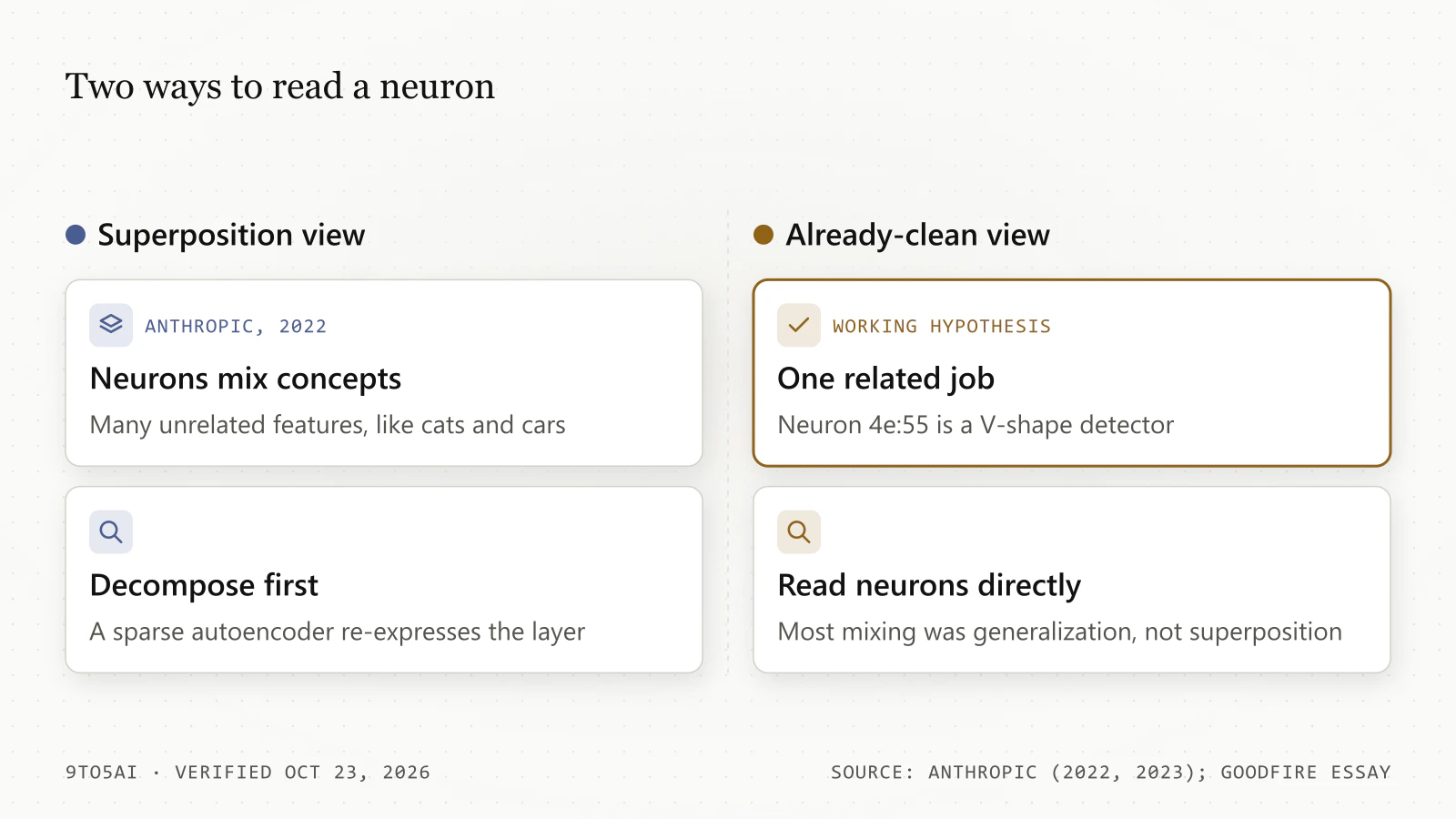
The hope was that each neuron would track one concept. Often it didn't seem to. Anthropic's "Toy Models of Superposition" paper (September 14, 2022) described neurons that are "polysemantic," responding to "many unrelated features." It proposed a reason: a model can represent "more features than they have dimensions," which the authors called superposition. If a network has to track more concepts than it has neurons, it packs several unrelated ones into each neuron and relies on them rarely showing up together.
If that's true, reading neurons one at a time is a dead end. You first have to unpack them.
What is a sparse autoencoder, and why did labs build them?
A sparse autoencoder (SAE) is a second, small network trained to re-express a layer's activity as a much larger set of "features," only a few of which are active at once. In "Towards Monosemanticity" (October 4, 2023), Anthropic trained one on a toy one-layer transformer with a 512-neuron layer and analyzed 4,096 features from one run. The paper said, "Sparse autoencoders produce interpretable features that are effectively invisible in the neuron basis." In May 2024, "Scaling Monosemanticity" applied the method to Claude 3 Sonnet, a production model, and reported that "Sparse autoencoders produce interpretable features for large models."
Anthropic describes itself as building "reliable, interpretable, and steerable AI systems," as our Anthropic explainer notes, and interpretability work shows up in its model reports, such as the Claude Opus 5.5 system card.
What does Goodfire's essay actually claim?
The essay's subtitle states the thesis: "The cause of polysemanticity in early model organisms wasn't superposition, but several ordinary, mostly fixable issues." Cammarata, who co-wrote the 2020 "Zoom In" circuits work with Chris Olah, now argues:
- Mixed-looking neurons usually do one thing. What looked like a mixture is often "recursive generalization: a neuron generalizing along more than one axis." A neuron that detects a shape may branch out to related shapes, which reads as a list of unrelated nouns if you describe it badly.
- The famous example was wrong. "The most famous polysemantic neuron is 4e:55 of InceptionV1, which looked like an arbitrary mixture of cats and cars." The essay says it's a V-shape detector, and that a circuit once thought to hide cars inside dog detectors reflects shared pose.
- Superposition should be a last resort. The essay says superposition would group unrelated things, while generalization groups related ones, so the two make opposite predictions. Cammarata says he no longer finds a real superposition circuit and that his own earlier example was an error.
- SAEs may be unnecessary. He writes, "I never saw the SAE grasp something fundamental the neurons didn't."
What evidence does the essay offer?
Most of it comes from image models. All numbers below are the essay's own; none has been independently reproduced.
| Claim | What the essay reports | Status |
|---|---|---|
| InceptionV1 last layer, 2017-era tools | "around 5%" of neurons readable | Author's estimate |
| Same network, better tools | "more like 50%" | Author's estimate |
| Same architecture, retrained with modern regularization | "more like 70%" | Author's estimate |
| Same-size ConvNeXt | "about 99%" | Author's estimate |
| Qwen3-32B, preliminary audit | ~90% of neuron poles have one main job, ~7% two related jobs, ~2–4% not yet understood | Preliminary; small samples; paper pending |
| SAE on a layer squeezed from 480 to 10 neurons | Explains 82% of variance, but splicing it in drops top-1 accuracy from 58.8% to 43.0% | One experiment |
Table 1Every figure is Goodfire-reported, and the language-model numbers are preliminary. Source: "Neural Networks Are Already Clean," Goodfire, checked October 23, 2026.
The essay says the readability percentages depend on where thresholds are set, and that "the precise number depends on where you set thresholds." A "pole" here is one direction of a neuron's output: the essay looks separately at what drives each neuron strongly positive and strongly negative.
The squeezing experiment is the closest thing to a direct test. Cammarata cut one InceptionV1 layer from 480 neurons to 10 and retrained. If superposition were the natural response to too few neurons, the 10 survivors should become tangled. He reports that they became broader detectors instead.
For language models, the essay says it found similar results in dense and mixture-of-experts models, including Kimi K3, and that "a technical companion paper will offer a more detailed account of language model neuron experiments." It gives no date.
How sure is Cammarata?
Less sure than the headlines. The essay labels its broadest claim "Highly speculative: this might be most of what we need, and interpretability might be far more tractable." It says large models aren't close to being fully understood and that current tools still have flaws. Some early InceptionV1 checkpoints were lost, so parts of the argument rely on retraining. Its circuit diagrams show connections tested by ablation, not complete circuits.
Cammarata told MIT Technology Review: "It's not infinitely good news; it's not everything solved."
How have researchers reacted?
Reaction split between enthusiasm online and skepticism from interpretability specialists:
- Neel Nanda, Google DeepMind: "I don't think it's a significant update to the big picture of interpretability," he told MIT Technology Review. The Decoder reported on October 16 that Nanda still believes superposition is real.
- Chris Potts, Stanford University: "As far as I can tell, nothing about this blog post makes the problems any easier."
- Jacob Hilton, Alignment Research Center: "this is giving the public an unrealistic picture of the state of the field." He cited an estimate that researchers understand less than 0.01% of what top models do inside.
- Oren Etzioni, formerly of the Allen Institute for AI: "What's new in 2026 is that he now accepts it. That's a recapitulation acknowledging a 40-year-old theory." MIT Technology Review traces that theory to a 1986 description of neurons by Geoffrey Hinton and others.
- Roon (@tszzl), an OpenAI employee on X: said the work "may be remembered as a major moment in scientific history," while noting that others still need to confirm it, according to The Decoder.
Anthropic, whose papers defined superposition and popularized SAEs, had no public response in the coverage cited here or in searches for this story, as of October 23, 2026. MIT Technology Review noted that Chris Olah, who worked on the original InceptionV1 research, co-founded Anthropic and leads its interpretability work.
What would confirm or refute it?
The essay doesn't list explicit falsification tests. Its critics' objections point to what would settle the question:
- The language-model paper. The 90% Qwen3-32B figure is the claim that matters for chatbots, and it rests on preliminary audits. A full method and data release would let others check it.
- Systematic scoring. Potts asked for rigorous evaluation across many examples, not hand-picked neurons. A common test is whether a written explanation can predict a neuron's activations on new inputs.
- Circuits, not single neurons. Hilton's point is that knowing what each neuron does isn't the same as knowing how they combine. Cammarata himself lists neuron combinations as an open question.
- Practical payoff. Nanda's test is whether neuron-level explanations help diagnose specific misbehaviors better than current tools.
- Evidence the other way. If SAEs reliably find directions that match no neuron and still change the model's behavior, that would count against the essay's central claim.
Even a confirmed result would have limits: our story on AI models that can provably hide capabilities covers an October 2026 paper showing that someone who tampers with weights can lock a skill away from any polynomial-time audit, including one with full access to every neuron. Readable neurons wouldn't remove the need to know who controlled the weights.
What's confirmed, reported and uncertain
- Confirmed (primary sources): the essay exists, by Cammarata with Curt Tigges and Tarun Gogineni; its subtitle, "working hypothesis" and "Highly speculative" labels; its reported numbers; the definitions in Anthropic's 2022 and 2023 papers.
- Reported: the October 15 publication date (LessWrong linkpost; the essay page is undated); researcher quotes (MIT Technology Review, October 19; The Decoder, October 16).
- Uncertain: the language-model results, which await a companion paper with no date; whether anyone can reproduce the vision-model percentages; how Anthropic's interpretability team views the claim.
About this story
Based on the sources linked below. How we report: Editorial standards.
Sources · 7
- Neural Networks Are Already Clean — Nick Cammarata, Goodfire
- Scaling Monosemanticity: Extracting Interpretable Features from Claude 3 Sonnet — Anthropic (May 21, 2024)
- Toy Models of Superposition — Elhage et al., Anthropic (September 14, 2022)
- Towards Monosemanticity: Decomposing Language Models With Dictionary Learning — Anthropic (October 4, 2023)
- "We were looking at it wrong": The explosive claim that's upended the AI world — MIT Technology Review (October 19, 2026)
- Is AI interpretability close to a breakthrough? A new essay has researchers divided — The Decoder (October 16, 2026)


Comments (0)