
What’s new, in 20 seconds
- On October 21, 2026, at GTC Berlin, Nvidia introduced DSX POD, a reference design for complete Vera Rubin AI factories built by 17 partners in modular containers. Nvidia says deployment at a prepared site drops from six months to 'as little as 14 days,' and expects DSX POD AI factories worldwide in early 2027.
- Nvidia says six suppliers, Amkor, IBIDEN, KYEC, Samsung Electro-Mechanics, SPIL and Unimicron, are expanding capacity for its products: 2.5x more substrate capacity over three years, 15x more co-packaged optics engines by mid-2027 and double the testing capacity from 2026 to 2027.
- Nvidia says its DSX platform can cut cooling water use by up to 100% with dry coolers, saving 54 million liters a day at 2 gigawatts versus cooling towers, and produce the same tokens with up to 30% less power. Both are vendor-reported 'up to' figures with no published method.
Contents
Nvidia DSX POD is a reference design for complete Vera Rubin AI datacenters that partners build inside modular containers and validate before delivery. Nvidia introduced it at GTC Berlin on October 21, 2026, saying it cuts deployment at a site that already has power and cooling from six months to "as little as 14 days." The same day, Nvidia said six suppliers are expanding the manufacturing capacity behind its chips, with targets of 2.5 times more substrate capacity and 15 times more co-packaged optics capacity. Every performance and capacity figure in both announcements is Nvidia's own.
This story is based on three Nvidia press releases and its GTC Berlin keynote blog, all dated October 21, 2026, plus DatacenterDynamics' report, checked October 23, 2026. Vera Rubin itself, which reached customer production in September, is covered in our Vera Rubin story.
The short version
- DSX POD: a containerized, pre-validated Vera Rubin AI factory design from 17 build partners; expected worldwide in early 2027.
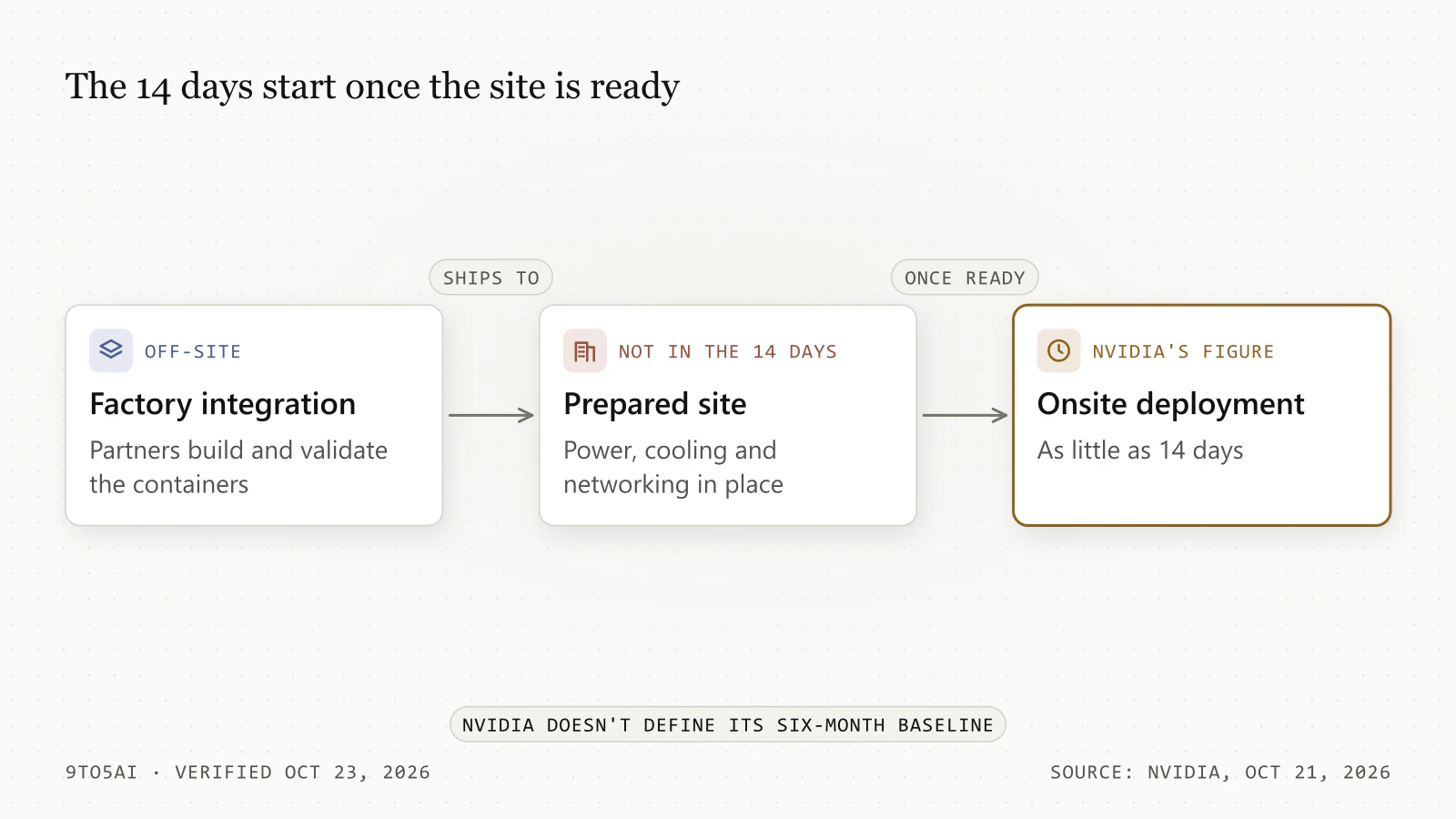
- The 14-day claim: applies only "at a prepared site," with power, cooling and networking already in place. Nvidia doesn't define its six-month baseline.
- Supply chain: six named suppliers expanding substrates, packaging, testing and optical engines, with dates from February 2027 to 2028.
- Efficiency: up to 100% less cooling water and up to 30% less power, both vendor-reported "up to" figures.
- Not disclosed: prices, GPU counts or megawatts per POD, and the total value of the supply deals.
What is Nvidia DSX POD?
DSX POD is part of Nvidia's DSX AI Factory Platform, its set of designs and software for building and running AI data centers. Nvidia's release describes DSX POD as "complete NVIDIA Vera Rubin AI factories" that partners build "inside modular containers." Computing, networking, cabling, rack-level power and liquid cooling are integrated at the factory. Partners then finish rack-to-rack cabling, wiring, piping and functional validation before shipping.
Nvidia's release doesn't give a rack or GPU count. In his keynote, Jensen Huang said "seven liquid-cooled compute racks connected with 17 km (11 miles) of Spectrum-X cables form one Vera Rubin DSX POD," DatacenterDynamics reported. DCD identifies the racks as Vera Rubin NVL72 systems.
The 17 named build partners are Anduril, Armada, Bull, Crusoe, DayOne, Dell Technologies, Delta, Eaton, Foxconn (Ingrasys), GIGABYTE, HPE, Lenovo, Pegatron, Quanta Cloud Technology, Schneider Electric, Vertiv and Wistron. No customers or sites were named. Nvidia expects DSX POD AI factories "worldwide in early 2027."
Huang's pitch was speed: "An AI factory creates value when it starts producing tokens — not when construction is complete." The 14-day figure covers onsite deployment once the site's utilities are ready, Nvidia's keynote blog says, not building the power and cooling plant, which is usually the slow part. Our gigawatt datacenter analysis found that power, gas turbines, transformers and financing, not chips alone, decide how much announced capacity gets built.
Which suppliers are expanding capacity, and by how much?
Nvidia's second release names six companies expanding capacity for its products. Huang said: "Demand is extraordinary. Capacity is the constraint."
| Supplier | What | Target, per Nvidia | Timing |
|---|---|---|---|
| IBIDEN (Japan) | Substrates, Ono Plant | 3x current levels; Nvidia pays a "multibillion-dollar" capacity reservation advance | Additional capacity ramps from Q1 2028 |
| Samsung Electro-Mechanics (South Korea) | Substrates | Immediate capacity from existing plants; upgrades and new factories in Sejong and Busan | Nvidia-allocated production "a significant portion" of its annual package substrate capacity by 2028 |
| Unimicron (Taiwan) | KF substrates, with a capacity reservation agreement | Not stated | Additions from Q2 2027; full capacity by mid-2028 |
| Amkor (South Korea) | Advanced packaging | More than 300% increase in interposer wafer capacity | By end of 2028 |
| KYEC | Chip testing, new US facilities; $1.1 billion capacity reservation advance from Nvidia | Not stated | High-volume production targeted for April 2027 |
| SPIL (Taiwan) | Optical engines for co-packaged optics | 15x increase, then another doubling | 15x by mid-2027; doubling by end of 2028 |
Table 1Most of the new capacity lands in 2027 and 2028, and Nvidia is prepaying at least two suppliers to reserve it. Source: Nvidia press release, October 21, 2026; all targets are Nvidia's.
Last verified: October 23, 2026
Across suppliers, Nvidia says it plans 2.5 times more substrate capacity over three years and expects total testing capacity to double from calendar 2026 to 2027, with buildouts in the US, Taiwan and Singapore. An unnamed Singapore testing expansion is due to start high-volume production in February 2027. The only dollar figures are KYEC's $1.1 billion and IBIDEN's unquantified "multibillion-dollar" advance, which the release says was agreed earlier in 2026.
Substrates are the layered boards that chips and memory sit on, and interposers link GPU dies to high-bandwidth memory inside one package. Co-packaged optics put optical transceivers next to the switch chip, replacing pluggable modules.
What efficiency does Nvidia claim, and on what basis?
A third Nvidia release, on European partners adopting DSX, carries the efficiency numbers. All are vendor-reported.
- Water: "up to 100%." DSX designs use closed-loop liquid cooling with outdoor dry coolers, which reject heat without evaporating water. At 2 gigawatts, Nvidia estimates savings of 54 million liters a day compared with conventional cooling towers, which it equates to the daily use of 180,000 households. Nvidia notes that local climate decides whether extra mechanical cooling is needed in the hottest periods, and says the designs support coolant temperatures up to 45°C.
- Power: "up to 30% less." Nvidia says DSX MaxLPS, which shifts power between workloads within a facility's fixed budget, can produce the same tokens with up to 30% less power. The release gives no test conditions for that figure. It cites two smaller results: a Lambda proof of concept on HGX B200 systems with 24% more token throughput and 19% more GPU capacity within a fixed power budget, and an Nscale evaluation in Iceland on four GB300 NVL72 racks with 49% higher inference throughput and 37% more GPU capacity within 264 kilowatts.
- Grid flexibility. In a trial with Emerald AI, EPRI, Nebius and the UK's National Grid, DSX Flex cut a Blackwell Ultra cluster's power draw by up to 40% during simulated grid events, Nvidia says.
None of these results comes from Vera Rubin hardware, and none was published with a method. Nscale, one of the evaluation partners, is the company whose Essex project lost Microsoft as an anchor, as our Nscale story reported.
Why it matters for AI data center buyers
Vera Rubin is the platform the biggest buyers are waiting for. Meta, for one, says Vera Rubin NVL72 racks come next in its Prometheus cluster, per our Prometheus story. DSX POD is Nvidia's attempt to sell more of the finished building, not just the chips, through partners who integrate everything off-site. The supply deals show where Nvidia sees bottlenecks: substrates, packaging, testing and optics, with most added capacity arriving in 2027 and 2028.
What's confirmed, reported and uncertain
- Confirmed (Nvidia releases, October 21, 2026): DSX POD's design, 17 partners and early-2027 timing; the six suppliers, their targets and dates; the $1.1 billion KYEC advance.
- Vendor-reported: the 14-day deployment time, the water and power savings, and the Lambda, Nscale and grid-trial results.
- Reported (DatacenterDynamics): Huang's description of seven racks and 17 km of Spectrum-X cable per POD.
- Uncertain: DSX POD pricing, power per POD, GPU count, named customers, and the total value of Nvidia's supply commitments.
About this story
Based on the sources linked below. How we report: Editorial standards.
Sources · 5
- NVIDIA Introduces DSX POD AI Factories to Accelerate Europe's Infrastructure Deployment — Nvidia Newsroom (October 21, 2026)
- NVIDIA and Supply Chain Partners Expand Capacity to Accelerate AI Infrastructure Buildout — Nvidia Newsroom (October 21, 2026)
- European Ecosystem Builds World's Most Efficient AI Factories With NVIDIA DSX — Nvidia Newsroom (October 21, 2026)
- GTC Berlin 2026: Live updates from NVIDIA CEO Jensen Huang's keynote — Nvidia blog (October 21, 2026)
- Nvidia launches DSX POD, claims the Vera Rubin reference architecture will make AI data centers more water and energy efficient — DatacenterDynamics, Charlotte Trueman (October 21, 2026)


Comments (0)