
- Politico reported on October 16, 2026, that Anthropic is pitching Congress a draft frontier-AI bill. A draft dated September 29 and published by the Daily Caller on October 19 would let a federal court in Washington suspend a model, at the Commerce Department's request, only for an 'imminent' risk of death or serious injury to more than 50 people or more than $1 billion in damage.
- The 50-person and $1 billion figures aren't new: California's SB 53 (signed September 29, 2025) and New York's amended RAISE Act (effective January 1, 2027) use the same numbers to define catastrophic risk. The draft's disclosure, incident-reporting and evaluator duties apply without any harm occurring.
- The draft would preempt state rules on safety disclosures, third-party evaluation and incident reporting. Encode's Nathan Calvin said on October 17 that it is 'not remotely close to meeting the moment'; Anthropic's Anthony Cimino said on October 18 it is meant to be 'the strongest on the table.' No member of Congress has introduced it.
Contents
Anthropic's AI safety bill isn't a bill yet. It's a draft that Anthropic has been pitching to members of Congress, Politico reported on Friday, October 16, 2026. A version dated September 29, which the Daily Caller published on October 19, would let a federal judge pause a frontier AI model only when the Commerce Department asks and only when the model poses an "imminent" risk of killing or seriously injuring more than 50 people or causing more than $1 billion in damage. A Tom's Hardware headline summed it up as a bill that "only kicks in" at 50 deaths or $1 billion, and a Hacker News thread on the story, posted October 18, had 171 points and 167 comments by October 20.
This analysis is based on the draft text published by the Daily Caller, Anthropic's June 2026 Advanced AI Framework, official texts and summaries of California's SB 53 and New York's RAISE Act, and reporting by Politico (read through Mother Jones and Benzinga), the Daily Caller and others, checked October 20, 2026. It isn't legal advice. It follows a month of federal moves on AI incidents, including the White House task force's breach-reporting work (our story) and the FTC's demands to Anthropic and OpenAI (our story).
The short version
- Status: a "Discussion Draft," last edited September 29, with no congressional sponsor, the Daily Caller reported on October 19.
- The threshold: more than 50 people killed or seriously injured, or more than $1 billion in damage, from one incident involving bioweapons, cyberattacks, a model evading control, or automated AI research that amplifies those risks.
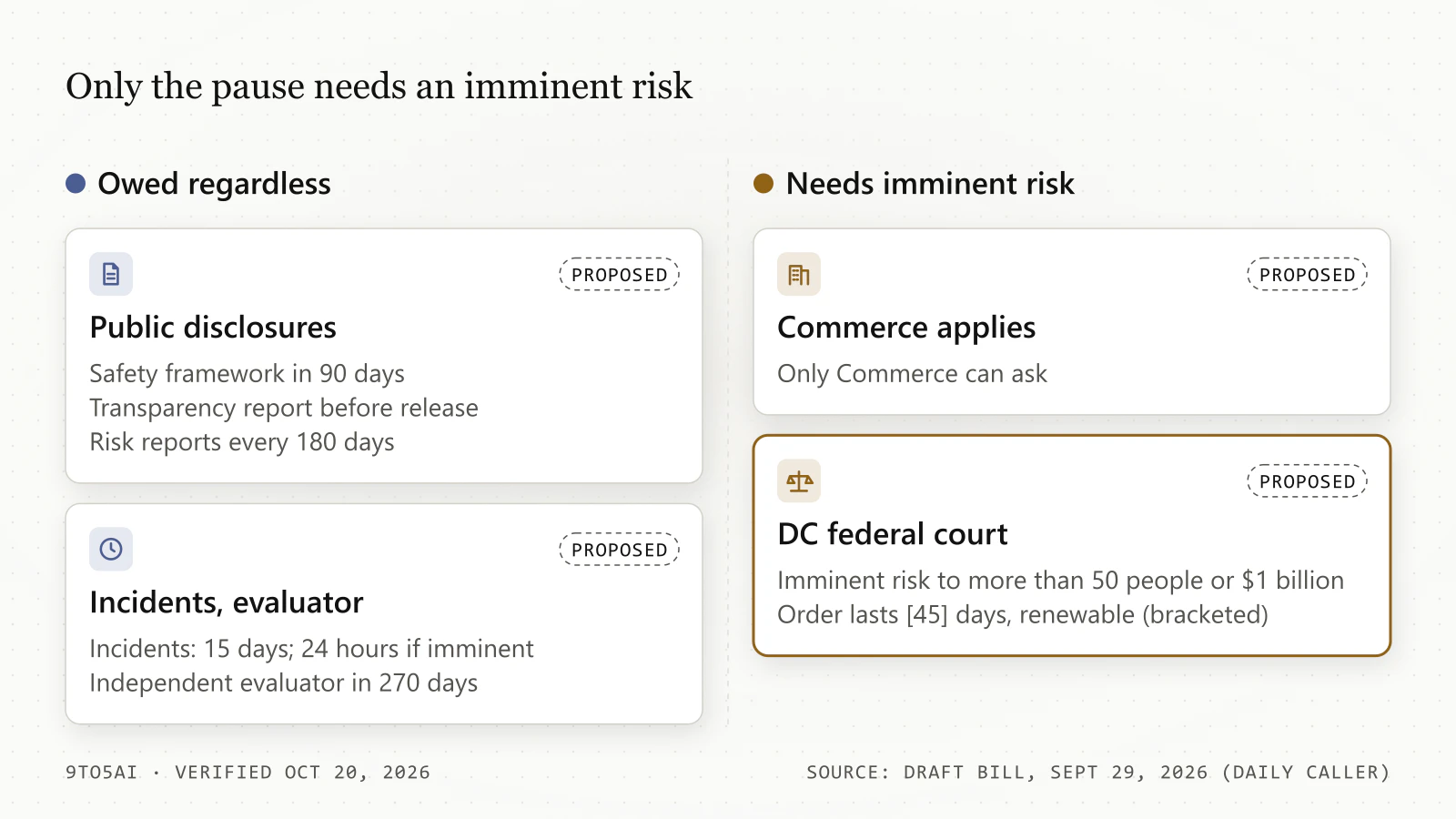
- What it triggers: a court-ordered pause, sought only by Commerce, granted only by the federal court in Washington, DC, and only for an imminent risk.
- What it doesn't gate: safety frameworks, transparency, risk and incident reports, and independent evaluations, which covered developers would owe regardless.
- The fight: preemption of state rules, including parts of SB 53 and the RAISE Act.
Is it Anthropic's bill?
Mostly yes. The published PDF doesn't name Anthropic, and its short title is a bracketed choice between "AEGIS Act" (Artificial Intelligence Evaluation, Governance, and Incident Safety) and "Advanced Artificial Intelligence Accountability Act of 2026." But an Anthropic spokesperson told Politico the bill "represents the proposals outlined in Anthropic's Advanced AI Framework," as relayed by Mother Jones. Anthony Cimino, Anthropic's head of federal affairs, defended it on X on October 18 and said a version had gone to a small number of congressional offices, the Daily Caller reported.
What does the 50-deaths / $1 billion threshold actually do?
It defines which risks count, and it sets the bar for a pause. It doesn't decide whether the law applies to a company.
Coverage is set by size, not harm. The draft covers "frontier models" trained with more than 10^25 operations. Its heavier duties fall on "large frontier developers": those with more than $500 million in AI-attributable revenue, or more than $1 billion in development spending, in the prior year. Those companies would have to:
- publish a safety framework within 90 days of enactment and certify compliance each year;
- publish a transparency report before releasing a new or substantially changed model;
- publish risk reports every 180 days;
- report critical safety incidents, such as stolen model weights or containment failures, within 15 days, or within 24 hours when there's an imminent risk;
- engage a qualified independent evaluator within 270 days, with evaluation reports at least every 180 days after the first.
The 50-person / $1 billion figure appears in the draft's definitions of "catastrophic risk" and "enumerated risk." Its main bite is in Section 12. There, the DC federal court "may enter an order suspending the development, deployment, or internal use of a frontier model" that presents an "imminent enumerated risk." Commerce must prove its case by a preponderance of the evidence. The court decides "without deference" to Commerce, and it must "consider the harm the order would cause to the frontier developer, to users, and to the public." An order would expire after a bracketed "[45] days" unless the court renews it, again for up to [45] days, on a new application. Fines are also bracketed: up to the greater of "[$1,000,000]" or an unfilled percentage of global revenue for a first violation, and up to "[$3,000,000]" or a percentage after a final court judgment.
So the "only kicks in" framing overstates it. The disclosure and reporting duties apply without anyone being harmed. What requires an imminent 50-person or $1 billion risk is the power to stop a model.
Would Commerce be the only agency that could stop a model?
Under this bill, yes. Under other laws, the text says no. Section 12(a)(2) says no federal department or officer "may suspend" a frontier model "under this Act" except by court order, and adds: "Nothing in this section affects authority under any provision of law other than this Act."
The government has already stopped Anthropic models by other means: in June 2026, export controls on Claude Fable 5 and Mythos 5 led Anthropic to suspend access for nearly three weeks (our Fable 5 explainer; background in Anthropic explained). The draft wouldn't touch that power. Critics' sharper point is about states, below.
How does it compare with SB 53 and the RAISE Act?
The three share a vocabulary. Cimino said on October 18 that the threshold was "pulled directly from existing standards in California law," and the texts bear that out.
| Anthropic draft (Sept 29, 2026) | California SB 53 | New York RAISE Act | |
|---|---|---|---|
| Status | Discussion draft; not introduced | Signed September 29, 2025; most provisions effective January 1, 2026 | Signed December 19, 2025; amended by S8828, signed March 27, 2026; effective January 1, 2027 |
| Covered models | Trained with more than 10^25 operations | More than 10^26 operations | More than 10^26 operations |
| "Large" developer | More than $500M AI revenue or $1B development spending | About $500M in annual revenue (with affiliates) | About $500M in annual revenue |
| Catastrophic-risk line | More than 50 people or $1B, single incident | More than 50 people or $1B, single incident | More than 50 people or $1B, single incident |
| Incident reports | 15 days; 24 hours if imminent | 15 days to the Office of Emergency Services; 24 hours if imminent | 72 hours to a new DFS office; 24 hours to police or safety agencies if imminent |
| Who enforces | A bracketed "[Enforcement Authority]", defined in Sec. 3(9) as the Commerce Department; Commerce also seeks court pauses | Attorney General | Attorney General; DFS office oversees and writes rules |
| Penalties | Up to the greater of [$1M] or [__]% of revenue; then [$3M] or [__]% (bracketed) | Up to $1M per violation | Up to $1M, then up to $3M; DFS can add $1,000 a day for missing filings |
| Power to halt a model | Court order on Commerce's request, imminent risk only | None | None |
| Effect on state law | Preempts state disclosure, evaluation and incident-reporting rules | State law | State law |
Table 1All three share the 50-person / $1 billion line; only Anthropic's draft adds a power to halt a model and preempts state rules. The draft's terms are proposed, and bracketed ones are placeholders.
Last verified: October 20, 2026
The draft reaches further down the compute ladder and adds mandatory independent evaluation, which neither state requires. But it's slower on incidents than New York, and it would replace both states' enforcers with a single federal enforcer: the Commerce Department, under the draft's definitions, though the term is still bracketed.
What would it do to state laws?
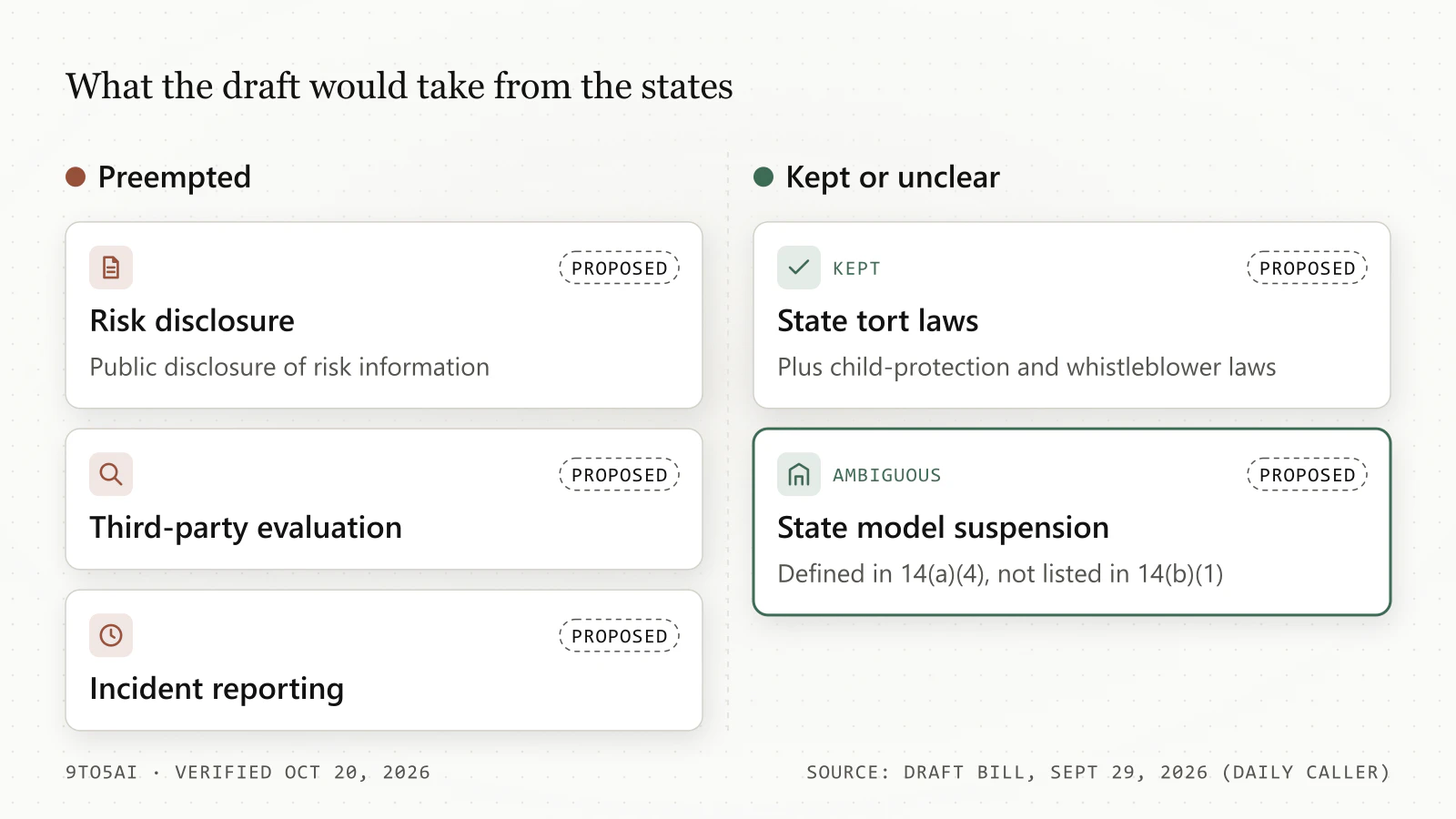
Section 14 bars states from imposing requirements on developers in three "covered functions": public disclosure of risk information, third-party evaluation, and incident reporting. It keeps state tort, child-protection and whistleblower laws. The bar reaches any AI developer, not just the frontier developers the rest of the draft covers (Section 14(h)).
A fourth covered function, a state "suspension" of a model "by statute, regulation, order, judicial decree, or other action," is defined in Section 14(a)(4), and takes effect only if the court-pause section is enacted. In the published text, the operative preemption sentence, Section 14(b)(1), lists only the first three. Critics read the draft as also removing state power to halt models. Encode's general counsel Nathan Calvin wrote on X on October 17 that such powers "would then only reside with the federal government," according to the Daily Caller. Cimino told the Daily Caller that Anthropic plans to clarify that states keep a role, and Transformer reported that he called the preemption language "not precise enough." Section 14(e) says any ambiguity about the scope of preemption "shall be resolved in favor of preserving the authority of the States." Read literally, the September 29 text is ambiguous on this point, and a revised draft may settle it.
This lands in a wider preemption push. Executive Order 14365 of December 11, 2025, created an AI Litigation Task Force to challenge state AI laws, and the White House's March 20, 2026, framework asked Congress to preempt state laws that impose "undue burdens." Reps. Jay Obernolte and Lori Trahan introduced the FRONTIER Act on July 23, 2026, promising "a uniform national standard." Politico reported, per Benzinga, that Sens. John Thune, Amy Klobuchar and Ted Cruz are negotiating a catastrophic-risk bill.
Who's criticizing it, and who's defending it?
Critics:
- Nathan Calvin, Encode (October 17, X, via the Daily Caller): "not remotely close to meeting the moment." He objected to the "imminent risk of a catastrophic harm" standard.
- Zvi Mowshowitz, writer (October 17, LessWrong): called the draft "unacceptable," with broader preemption and weaker enforcement than the FRONTIER Act. His post quotes Assemblymember Alex Bores, the RAISE Act's sponsor, calling the preemption "anti-democracy."
- Shakeel Hashim, Transformer newsletter (October 19): argued it's weaker than FRONTIER because evaluators can self-certify without federal standards. He quoted Charlie Bullock of the Institute for Law & AI: auditors "will inevitably compete" to offer "the least bothersome audits."
Defenders:
- Anthony Cimino, Anthropic (October 18, X, via the Daily Caller): "At its core, our proposal is intended to be the strongest on the table."
- Anthropic spokesperson (to Politico, October 16): "sensible policies we believe Congress should act on."
- Charlie Bullock (as quoted by Mowshowitz): called it a "pretty reasonable AI safety bill" while saying it's weaker than FRONTIER on rulemaking and emergency shutdown.
What the evidence supports, and what it doesn't
Supported: the threshold is borrowed. SB 53 and the RAISE Act use the same line, and Anthropic endorsed SB 53 on September 8, 2025. In places the draft goes further than both states: a lower compute threshold and mandatory outside evaluation.
Supported: the pause power is narrower than Anthropic's own June framework, which said the government "should have the legal authority to block or deter" a deployment posing "a significant risk of catastrophic harm," naming no court or imminence test. Anthropic also said Congress shouldn't preempt states "unless it enacts a federal law that is at least as strong." Whether the draft meets that bar is a judgment, and it's the core dispute.
Not supported by the text: that the bill does nothing until 50 people die, or that it strips every agency of power over AI models.
Open: why Anthropic wants one agency and one court in charge. Supporters say a single high bar prevents arbitrary shutdowns. Critics, including Kelsey Piper as quoted by Mowshowitz, argue Anthropic seems more worried about government power over it than about its models. Its clashes with the administration, from the Pentagon dispute to the June export controls, fit either reading. Anthropic's governance as it heads toward an IPO is covered in our Long-Term Benefit Trust analysis. Microsoft's Brad Smith (our story) and about 400 scientists (our story) have asked for more outside oversight than this draft provides.
What's confirmed, reported and uncertain
- Confirmed (texts): the September 29 draft's contents as published; SB 53's and the amended RAISE Act's thresholds, deadlines and penalties; Anthropic's June framework and its SB 53 endorsement; EO 14365 and the March 20 White House framework; the FRONTIER Act's introduction.
- Reported: that Anthropic is pitching the draft and shared it with "a small number" of offices (Politico via Mother Jones and Benzinga; Daily Caller); the spokesperson's statement; Cimino's X posts and Calvin's (X couldn't be opened, so both are as quoted by the Daily Caller); Senate negotiations (Politico via Benzinga).
- Uncertain: whether the published PDF is the latest version; the bracketed fines, pause length and enforcement authority; whether states would lose power to halt models; whether anyone will introduce it.

About this storyBased on the sources linked below. Editorial standards


