
- Anthropic's Long-Term Benefit Trust, announced September 19, 2023, holds Class T stock that lets financially disinterested trustees elect and remove a growing number of directors. Anthropic said on April 14, 2026, that trust-appointed directors now make up a majority of its board.
- The trust was designed for five trustees. Anthropic's company page lists three on October 20, 2026: Neil Buddy Shah, Richard Fontaine and Ben Bernanke. Tino Cuéllar left on August 4, 2026, to become Anthropic's chief global affairs officer.
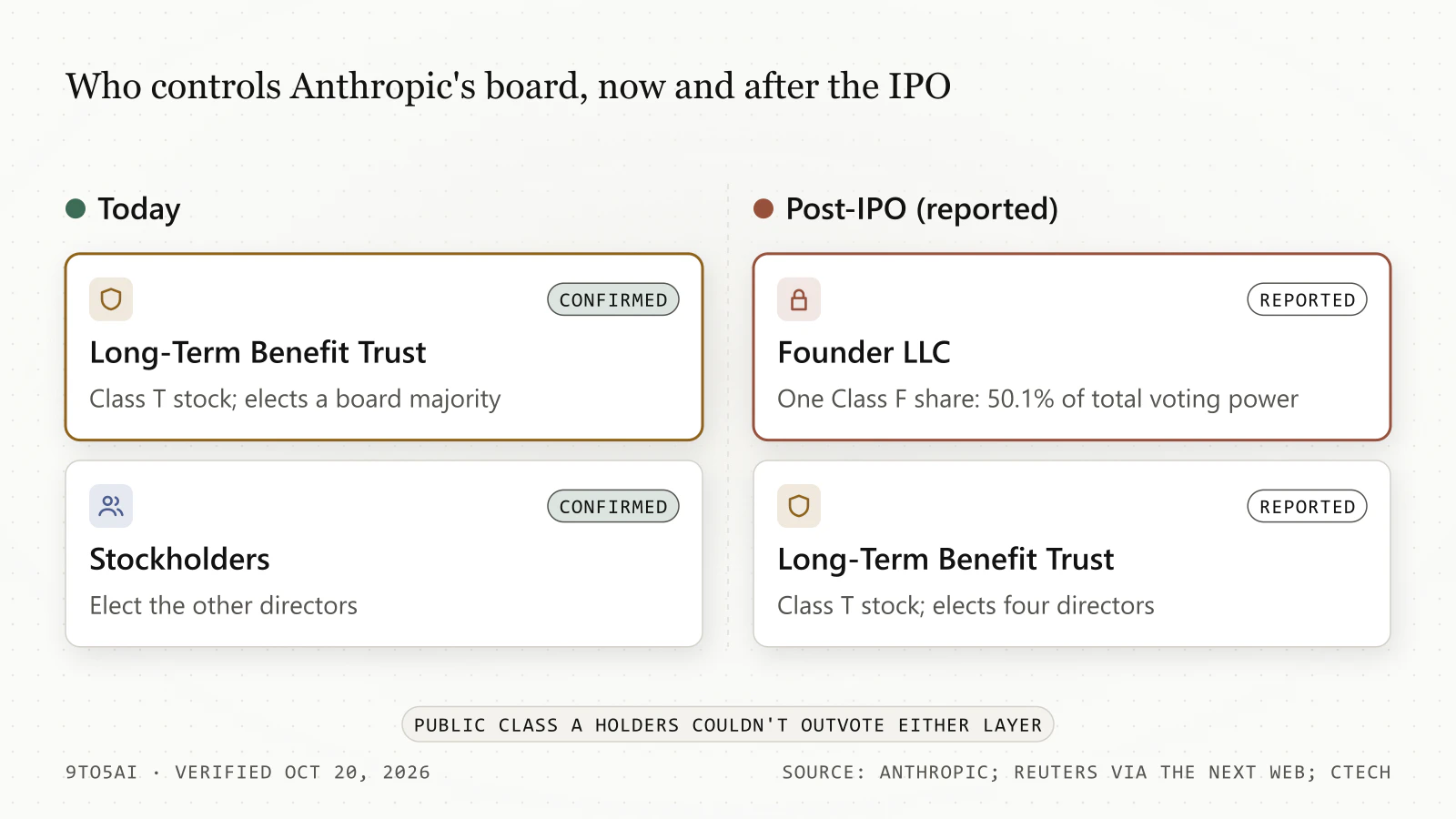
- Reuters reported on September 29, 2026, from the draft IPO prospectus, that a Founder LLC of the seven co-founders would hold 50.1% of the vote. Accounts of the same draft say that comes through one Class F share and that the trust would elect four directors. Anthropic hasn't published the prospectus.
Contents
Update, October 20, 2026: On October 18, Anthropic separately announced a Public Benefit Fund that would hold 5% of its shares, subject to stockholder approval. Anthropic's post doesn't mention the Long-Term Benefit Trust. See Anthropic's Public Benefit Fund.
The Anthropic Long-Term Benefit Trust is a small group of outside trustees, with no financial stake in Anthropic, that can elect and remove some of its directors. In a story Techmeme featured on Monday, October 19, 2026, the Wall Street Journal's Theo Francis described an "opaque, five-member" trust whose members "own no Anthropic equity but hold enormous sway by appointing most of its board," according to Techmeme's headline. Public shareholders would be buying into a company where neither they, nor the venture investors before them, choose most of the board. Anthropic said on April 14, 2026, that directors appointed by the trust now hold a board majority.
This analysis is based on Anthropic's own posts about the trust, its board and its confidential IPO filing, a 2023 description of the structure by Anthropic's outside counsel, Reuters' reporting on the draft prospectus (read through The Next Web) and CTech's account of the same draft, SEC filings by Meta and Alphabet, and OpenAI's structure page, checked October 20, 2026. The WSJ article is paywalled and wasn't read; its claims appear here only where a summary could be checked. It explains structures and reports. It isn't investment advice. For the IPO timetable and price reports, see our Anthropic IPO explainer.
The short version
- What it is: a Delaware "purpose trust" set up in 2023 whose trustees hold a special Class T stock. That stock lets them elect a phased-in number of directors and entitles them to notice of certain major actions.
- Board control today: Anthropic said on April 14, 2026, when the trust appointed Novartis CEO Vas Narasimhan, that trust-appointed directors are a majority.
- Trustees today: three listed (Shah, Fontaine, Bernanke) in a structure built for five.
- The limit: Anthropic said in 2023 that large stockholder supermajorities can change the trust without the trustees' consent.
- Reported IPO change: a founders' Class F share with 50.1% of the vote, alongside the trust electing four directors, per reports on the draft prospectus (Reuters, via The Next Web; CTech). Not confirmed by Anthropic.
How does the Long-Term Benefit Trust work?
Anthropic announced the trust on September 19, 2023. Its post describes "an independent body of five financially disinterested members" whose purpose matches Anthropic's public benefit purpose. The mechanics, as Anthropic and its lawyers described them:
- Class T stock. Created at the close of Anthropic's Series C, it's held only by the trust. It gives the trust the right to elect and remove a phasing-in number of directors, plus "protective provisions" that require the trust to receive notice of "certain actions that could significantly alter the corporation or its business."
- A phase-in. The trust's seats grow on "time- and funding-based milestones." Anthropic said the trust would elect a majority "within 4 years." A 2023 post on the Harvard Law School Forum on Corporate Governance, by Yale's John Morley and Wilson Sonsini's David Berger and Amy Simmerman (Anthropic's outside counsel), described a five-seat board rising from one trust seat to three.
- Self-selection. Anthropic's board picked the first trustees. Later trustees are elected by the sitting trustees, in consultation with the company. Terms last one year.
- A failsafe. The trust can be changed by agreement between the trustees and the board or stockholders. It can also be changed without trustee consent "if sufficiently large supermajorities of the stockholders agree," with the required majority rising as the trust's power grows. Anthropic hasn't published the percentages.
Anthropic is also a Delaware public benefit corporation. Its stated purpose is "the responsible development and maintenance of advanced AI for the long-term benefit of humanity," and its directors may weigh that purpose alongside shareholder returns (our Anthropic explainer).
Who are the trustees?
Turnover has been high. Of the five original trustees, only the chair, Neil Buddy Shah, remains.
| Date | Change | Source |
|---|---|---|
| September 19, 2023 | Original five: Jason Matheny, Kanika Bahl, Neil Buddy Shah (chair), Paul Christiano, Zach Robinson | Anthropic LTBT post |
| December 2023 | Matheny steps down (RAND policy conflicts) | Anthropic LTBT post |
| April 2024 | Christiano steps down to join the US AI Safety Institute | Anthropic LTBT post |
| May 2025 | Richard Fontaine joins | Anthropic LTBT post |
| January 2026 | Bahl and Robinson leave; Tino Cuéllar joins (announced January 21) | Anthropic |
| July 2026 | Ben Bernanke joins | Anthropic LTBT post |
| August 4, 2026 | Cuéllar steps down to become Anthropic's chief global affairs officer; trust to pick a successor | Anthropic |
| October 20, 2026 | Company page lists Shah, Fontaine, Bernanke | Anthropic company page |
Table 1Of the five original trustees only Neil Buddy Shah remains, and three are listed today in a trust designed for five. Source: Anthropic.
Last verified: October 20, 2026
Two discrepancies are worth noting. The editor's notes on Anthropic's 2023 trust post record Cuéllar joining but not his departure, though Anthropic's August 4 announcement says he "stepped down from the Trust." And Techmeme's headline for the WSJ story calls it a "five-member" trust, which matches the design, not the current roster.
Who elects Anthropic's board today?
Anthropic's company page says the board is "elected by stockholders and the Long-Term Benefit Trust." It lists six directors on October 20: Dario Amodei, Daniela Amodei, Yasmin Razavi, Reed Hastings, Chris Liddell and Vas Narasimhan.
Anthropic has identified some trust appointees. Its January 2026 trustee post named Jay Kreps and Reed Hastings, and its April 14 post said the trust appointed Narasimhan and that, with him, trust-appointed directors "now make up a majority of the Board." Kreps isn't on the current list, and Anthropic hasn't said publicly who appointed Liddell, who joined in February 2026, so the current split can't be confirmed from its pages. The 2023 post also gives Series C and later investors one seat of their own.
What does the IPO change?
Here the facts thin out. Anthropic confirmed on June 1, 2026, only that it had confidentially submitted a draft S-1; its announcement says nothing about governance. Everything below is reported.
- Founders' super-vote. Reuters, which reviewed the draft prospectus, reported on September 29 that the seven co-founders would hold 50.1% of the voting power through a new Founder LLC, according to The Next Web. CTech's account of the draft, the same day, says the LLC would hold a single Class F share carrying 50.1% of total voting power. The arrangement would start to sunset once two or fewer founders or their successors remain. A founder could be removed for leaving, death, selling too much stock, or cause. The Information first reported a founder super-voting plan on August 18, according to Tech Times.
- The trust keeps its seats. The Next Web and CTech both say the trust would elect four directors. The Next Web adds that Class F and Class A holders would elect the other three, the two Amodeis and one unnamed director, which implies a seven-seat board. The draft itself isn't public.
- A warning to buyers. Anthropic's draft says its governance could lead to decisions that "conflict with the short-, medium- or long-term financial interests of shareholders," hurting the value of its Class A stock, per CTech.
- The WSJ's focus. Techmeme's headline for the October 19 story by Theo Francis says the trust's members "own no Anthropic equity but hold enormous sway," and its summary describes a trust "empowered to shape its board and block major moves." Anthropic's own 2023 description speaks of required notice of significant actions, not a veto. The full WSJ text couldn't be checked.
- Investor pushback. New York City Comptroller Mark Levine wrote to Dario Amodei on October 14 urging a pause in the IPO, citing reports that control could be concentrated among founders and trustees, Benzinga reported.
If the reported terms hold, public Class A holders would face two layers they can't outvote: founders with a fixed majority of votes, and trustees who elect four directors without owning shares. The IPO financials behind the valuation are in our story on the $16.8 billion quarter, and the debt side in our credit-rating story.
How does it compare with OpenAI, Meta and Alphabet?
| Company | Who controls the board | How | Controller's economic stake | Source |
|---|---|---|---|---|
| Anthropic today | Trust-appointed directors are a majority (Anthropic, April 14, 2026) | Class T stock held by the trust | None; trustees are financially disinterested | Anthropic |
| Anthropic after IPO (reported) | Founders hold 50.1% of votes; trust elects four directors | Class F share via Founder LLC; Class T | Founders: undisclosed; trust: none | Reuters via The Next Web; CTech, September 29, 2026 |
| OpenAI | OpenAI Foundation (nonprofit) appoints all of OpenAI Group PBC's directors | Special voting rights | About 26% equity, plus a warrant | OpenAI, October 28, 2025 |
| Meta | Mark Zuckerberg controls a majority of voting power (as of April 1, 2026) | Class B stock, 10 votes a share | Minority of shares | Meta 2026 proxy; exhibit to 2023 10-K |
| Alphabet | Larry Page and Sergey Brin: about 52.7% of voting power (as of December 31, 2025) | Class B stock, 10 votes a share; Class C has no vote | Minority of shares | Alphabet 2025 10-K |
Table 2Anthropic's trust is the only controller here with no economic stake at all; the post-IPO row is reported, not confirmed by Anthropic.
Last verified: October 20, 2026
The closest match is OpenAI (OpenAI explained), where a mission body with a sizable but minority stake picks the board. Anthropic's trust is stranger in one way: it owns no equity at all. Meta and Alphabet are ordinary founder-control structures, where the people in control also own large stakes. Anthropic's reported plan would combine both models: founder voting control and a mission trust.
What the evidence supports, and what it doesn't
Supported: the trust's board power is real and documented. Anthropic says trust appointees are a majority, and the Class T mechanism is in its own posts and its lawyers' description.
Supported: the trust's independence has limits. Stockholder supermajorities can amend it without trustee consent, according to Anthropic. The trust has also run below its designed size for most of 2026, and one trustee moved straight into a senior company job.
Not established: that the trust can veto deals. Anthropic's public description says notice, not consent. The WSJ's "block" wording may reflect provisions in documents that aren't public, and that can't be checked here.
Not established: how the reported founder majority and the trust would interact. If founders hold 50.1% of all votes, they would decide the stockholder-elected seats and most shareholder votes, including, possibly, any supermajority needed to change the trust. Whether the founders could reach those thresholds alone depends on terms that aren't public. The public S-1 should settle it.
The same governance question runs through Anthropic's policy work. Its draft federal safety bill would concentrate power to pause models in one agency and one court (our analysis), and critics have asked whom that structure answers to.
What's confirmed, reported and uncertain
- Confirmed (Anthropic): the trust's design and Class T stock (2023); trustee changes through July 2026; Cuéllar's August 4 move; the April 14 board-majority statement; the current trustee and director lists; the June 1 confidential S-1.
- Confirmed (filings): OpenAI's structure (OpenAI); Meta's and Alphabet's class voting (SEC filings).
- Reported: the Founder LLC, Class F 50.1% vote, four trust-elected directors and the shareholder-conflict risk factor (Reuters via The Next Web; CTech); a super-voting plan (The Information via Tech Times); the WSJ's description of the trust (via Techmeme's headline and summary); Levine's letter (Benzinga).
- Uncertain: the supermajority percentages, which actions require notice to the trust, post-IPO board size, whether Cuéllar's seat will be filled before the IPO, and final terms in the public S-1.

About this storyBased on the sources linked below. Editorial standards


